 |
| submarine spotting |
I also wonder what my neighbors think of me doing a panther crawl down to the weed wall only to catch loads of bluegill.
 |
| if all the gills were this size they wouldn't be so annoying |

|
| submarine spotting |
|
| if all the gills were this size they wouldn't be so annoying |
 Is it possible that I've over-hyped terrestrials?
I pondered this question as I hiked the long path down into the valley of a relatively unknown trout stream. With each step more and more grasshoppers fluttered and jumped out ahead of me. These were the really big hoppers, some two inches long.
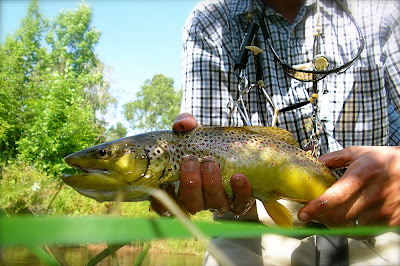
I've always had a thing for fishing terrestrials, ever since the first time I caught a fish on a hopper. Like most of my flyfishing successes, my first fish on a hopper was mostly by accident. I was fishing the meadows section of the Bois Brule river in northern Wisconsin during August. Soon I would learn that there are much better sections of river farther upstream for summer fishing. The meadows is deep and narrow, lacking the riffles and runs more characteristic of other portions of the Brule and of most good trout streams. Yet the gentle currents made it easy to fish a dry fly or strip a steamer. On this particular day I was fishing an indicator-nymph rig and on my first drift along an alder choked corner a nice brown came up and hammered my indicator. I can still remember the silhouette of the fish as it moved slowly out of the deep water and pushed its nose above the surface, then pulled its head down and away with my neon green foam ball. At times like these you wonder why one would get any sense of accomplishment from catching a trout. I replaced my indicator and nymphs with a big yellow hopper and on the first cast that same brown rose in the same way, taking it in its mouth and moving down and away again. It was a nice heavy fish that put up a fantastic fight. I landed it and snapped a photo (see above).
Further along my walk down to the stream I started to assess whether my interest in fishing terrestrials was at all justified by past successes. Had I really done that well on hoppers, ants, crickets and the like? The first year that I moved south to the driftless area I caught a number of trout on a hopper on an Iowa stream as late as October (see below). I am proud to say that it did not require a fish first striking at my indicator.
 The next summer I fished ants and crickets as early as June and I caught fish, albeit small ones. Later that fall and the following one I caught a number of bigger fish (12-16 inches) on hoppers in late September in Minnesota. On one of those trips my son, Sam, came along. Of course I don't remember not catching fish on terrestrials because if they aren't working, I typically fish something else. In fact, that realization is probably more telling than anything. When fish are taking terrestrials, I fish them and I love it. When they aren't, I'm not, and I don't spend too much time thinking about it. But when its good, it is really good. It is the type of fishing most of us yearn for in the summer months. Tie on something big that floats and start casting. Let your mind wander, have fun.
 The stream I was fishing was small and shallow. The last time I had been here was two years ago with my daughter, Halene. At that time, we were mostly hiking and scouting new water. That was August and we did manage a nice-sized brown on a hopper then too. Now I worked my way up through a pasture section taking several 10 inch trout on a hopper. As the sun dropped below the bluff to the west, the fish turned on. For about a half hour stretch the little trout were racing each other to reach my fly. I had one fish that was bigger come up and miss my fly on the first pass and then take it on the second pass through. I lost that fish.


 |
 Working the fly slooooowwww.
 The fish of the night. I hooked him pretty good with a big bushy rope fly.

 |
| image credit: google maps |
 |
| The walk from the road to Sugarbottom flat for some gold fish. |
 |
| The finger on the left is a fair carpin' backwater. Image of Coralville Res. Image Credit Google Maps. |
 |
| Finger on the right - sugarbottom flat on Coralville Res. Image Credit Google Maps. |

 |
| carp on SJW. from Lake MacBride flats. |
 |
| not a pike. from Wapsi River, on 6" streamer |
 |
| the Wapsi |
 |
| Coralville Reservoir |
 |
| eye contact is one tip to catching more carp |
 To the studio...
 Ink
Ink rub
rub pull
pull
 Most of you know that I'm somewhat obsessed with bison. I still consider Alan Knapp's work to be one of the main reason I got into ecology. I remember having to write a literature review paper for my ecology class as an undergrad. Somehow I came across Knapp et al's Bioscience paper. I was seriously floored and forever hooked on plant-herbivore interactions. Bison are the essence of renewable energy. Someday I'll own some land with a small herd. In Custer State Park, bison are common and most people don't think it is too impressive to see one or a dozen. I thought it was great. It is simply the most impressive mammal in North America.
 I fished French Creek in Custer State Park. It was full of rainbows. On my way there at 4:30 am, I saw a mountain lion. I was in my car, it was in the ditch, it looked at me, walked around the car, and then ran off. It was awesome-from my car.
 I never got what I would call a 'big' fish, but I had a blast.
 More bison on the edge of the badlands. Doesn't this photo just emanate ecosystems ecology?
 I did a little branch trimming and dropped a couple of trees behind the house. I didn't feel real great about it, but it does allow me to see the gar roll from the deck. Now if I could just catch one, I suck...
 The wood already under the shed should get me through the next two years. The wood piled up could get me through another two years. Seeing this reminds me of something I read the other day. "A lady asked me if heating with wood really saved that much money on my heating bill. I replied, I don't have a heating bill."
 The retaining wall is leveling off an area where we will eventually have a fire pit.
 The fence keeps the rug rats in.
 Potatoes on the left, strawberries on the right. The strawberries did great this year. Next year this entire bed will be strawberries.
 The garden is growing well. That is a newly constructed compost bin in the background.

 |
| chopped head and blurred fish. shooting with a timer... almost the money shot |
 |
| The silver of a quillback |

 |
| good looking warmwater stream in Iowa |


